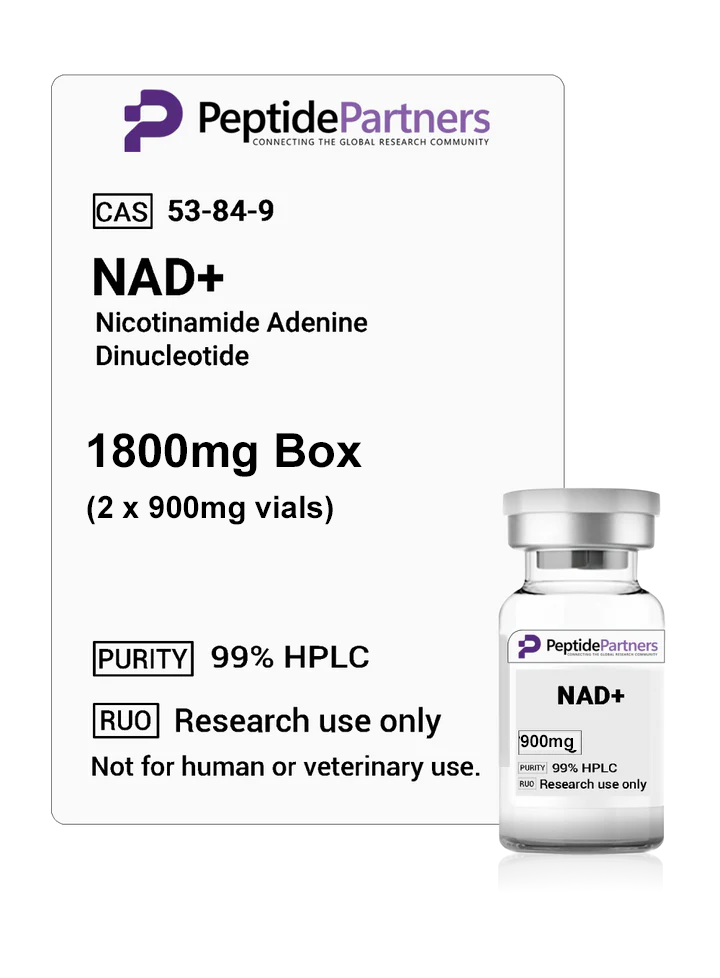


NAD+ Buffered (900mg vials)
Price range: $198.00 through $738.00
• Purity: 99.55% (multi-vial, independently tested)
• Format: 900mg vials (10 mL capacity)
• Box Options: 1800mg, 4500mg, 9000mg combinations
• Testing Status: Endotoxin, heavy metals & purity screening PASSED
• Cost Efficiency: $0.08 – $0.11 per milligram
NAD+ (nicotinamide adenine dinucleotide) is a critical redox cofactor and enzyme substrate investigated for its role in cellular metabolism, mitochondrial function, DNA repair pathways, and sirtuin activation. This research-grade material supports in-vitro experimentation focused on NAD+/NADH redox balance, metabolic reprogramming, senescence reversal models, and neuroprotection mechanisms.
- Independent certificate details, manufacturer IDs, and batch IDs should be reviewed before purchase when available.
- Order cancellations for full refunds are available before shipment; shipped orders cannot be cancelled or refunded.
- For damaged or incorrect goods, photograph the outer packaging, inner packaging, and product labels, then email support within 48 hours of carrier delivery.
Buy NAD+ Buffered – Peptide Partners
Product Overview & Specifications
NAD+ (nicotinamide adenine dinucleotide) is a critical redox cofactor and enzyme substrate investigated for its role in cellular metabolism, mitochondrial function, DNA repair pathways, and sirtuin activation. Peptide Partners supplies this research-grade material for in-vitro testing, laboratory experimentation, metabolic biochemistry, structural biology, and preclinical cellular research.
Published studies have examined NAD+ using mammalian cell culture models, mesenchymal stem cell senescence assays, neuronal oxygen-glucose deprivation models, enzymatic activity measurements, metabolomic profiling, and DNA repair pathway analyses. Research areas include NAD+/NADH redox balance, Sirtuin-1 activation, base excision repair (BER) pathway modulation, mitochondrial bioenergetics, metabolic reprogramming, and cellular stress responses.
The product name supplied for this listing is “NAD+ Buffered.” Researchers should verify the exact identity, formulation, buffer composition, and batch-specific certificate of analysis before beginning any experiment. Findings from published NAD+ studies should not be assumed to apply to every commercial batch or formulation.
Product Specifications
| Specification | Details |
|---|---|
| Product name | NAD+ Buffered |
| Compound type | Nicotinamide adenine dinucleotide (oxidized form) |
| Primary molecular targets | NAD+-dependent enzymes (Sirtuins, PARPs, CD38), redox enzymes, DNA repair machinery |
| Primary research areas | Cellular metabolism, NAD+/NADH redox balance, mitochondrial function, DNA repair pathways, sirtuin activation, senescence modulation, and neuroprotection |
| Product format | 900 mg vials |
| Vial size | 900 mg |
| Vial capacity | 10 mL |
| Available box combinations | 1800 mg, 4500 mg, and 9000 mg |
| Multi-vial purity | 99.55% |
| Independent testing | Yes |
| Endotoxin screening | Passed |
| Heavy-metals screening | Passed |
| Purity screening | Passed |
| Manufacturer ID | WF03 |
| Batch ID | NDB202606 |
| Cost per milligram | $0.08–$0.11 |
The stated 99.55% purity is based on multi-vial testing. Researchers should review the batch-specific certificate of analysis before beginning any experiment.
Primary Research Studies & Findings
Dihydronicotinamide Riboside Is a Potent NAD+ Concentration Enhancer In Vitro and In Vivo
Authors: Yue Yang, Farheen Sultana Mohammed, Ning Zhang, and Anthony A. Sauve
Publication: Journal of Biological Chemistry, 2020
DOI: 10.1016/j.jbc.2020.100354
Reference: View publication
This study reports the synthesis of dihydronicotinamide riboside (NRH) and its evaluation as a potent NAD+ precursor. In vitro experiments using various mammalian cell lines demonstrated that NRH administration led to a rapid and substantial increase in intracellular NAD+ concentrations, ranging from 2.5- to 10-fold over control values within one hour. Comparative analysis with established NAD+ precursors, nicotinamide riboside (NR) and nicotinamide mononucleotide (NMN), revealed that NRH consistently exhibited superior efficacy in augmenting NAD+ levels at equivalent concentrations.
Furthermore, NRH treatment significantly increased the NAD+/NADH ratio in cultured cells and conferred protection against cell death induced by genotoxic agents like hydrogen peroxide and methylmethane sulfonate. Mechanistic investigations indicated that NRH is not an inhibitor of NAD+ consumption but rather serves as a biochemical precursor. Cell lysates were found to possess an ATP-dependent kinase activity that efficiently converts NRH to nicotinamide mononucleotide (NMNH), independent of the known NR kinases Nrk1 or Nrk2, suggesting the existence of a novel metabolic pathway for NAD+ biosynthesis.
The findings establish NRH as a highly efficient NAD+ precursor with potential applications in metabolic research, cellular stress models, and studies of NAD+-dependent enzyme systems. The research highlights the importance of NAD+ homeostasis in cellular protection and metabolic regulation.
Plain-English Research Summary
Researchers have developed a new compound called dihydronicotinamide riboside (NRH) that acts as a powerful booster for cellular energy. In laboratory experiments conducted on cells, NRH was found to be significantly more effective at increasing the levels of a crucial molecule called NAD+ compared to other similar substances. This increase in NAD+ helps to improve the cell’s energy balance and protects it from damage caused by stress. The study suggests that NRH works through a previously unknown pathway in the cell, opening up new possibilities for developing therapies that target cellular metabolism and aging.
NAD+/NADH Redox Alterations Reconfigure Metabolism and Rejuvenate Senescent Human Mesenchymal Stem Cells In Vitro
Authors: Xuegang Yuan, Yijun Liu, Brent M. Bijonowski, Ang-Chen Tsai, Qin Fu, Timothy M. Logan, Teng Ma, and Yan Li
Publication: Communications Biology (Nature), 2020;3:782
DOI: 10.1038/s42003-020-01514-y
Reference: View publication
This study investigates the role of NAD+/NADH redox balance in the replicative senescence of human mesenchymal stem cells (hMSCs) during in vitro expansion. The researchers found that prolonged cell culture leads to a decline in the intracellular NAD+/NADH ratio and reduced activity of Sirtuin-1 (Sirt-1), a NAD+-dependent deacetylase. This was accompanied by a metabolic shift towards glycolysis and diminished mitochondrial fitness, characteristic of cellular senescence.
Treatment of late-passage hMSCs with the NAD+ precursor nicotinamide (NAM) successfully restored intracellular NAD+ levels, rebalanced the NAD+/NADH ratio, and enhanced Sirt-1 activity. Consequently, NAM-treated cells exhibited a partial reversal of the senescent phenotype, including improved mitochondrial function and a rejuvenated metabolic profile. In contrast, human dermal fibroblasts (hFBs) showed a more stable NAD+/NADH balance and limited senescence during in vitro expansion, highlighting a key metabolic distinction between stem cells and differentiated cells.
The findings demonstrate that NAD+ homeostasis plays a critical role in maintaining stem cell function and that restoring NAD+ levels can reverse aspects of cellular senescence in laboratory models. The research provides insights into metabolic regulation of stem cell aging and potential strategies for maintaining cellular fitness.
Plain-English Research Summary
As we age, our bodies’ stem cells, which are responsible for repairing tissues, can become old and less effective. Scientists have been studying why this happens by growing human stem cells in the lab. They discovered that as the stem cells multiply, their energy balance gets disrupted, leading to a decrease in a vital molecule called NAD+. This, in turn, causes the cells to age and lose their regenerative abilities. In this study, the researchers found that by giving the aging stem cells a vitamin B3 derivative, they could boost their NAD+ levels. This simple intervention helped to restore the cells’ energy balance, improve their function, and essentially make them ‘younger’ again.
Cellular NAD Replenishment Confers Marked Neuroprotection Against Ischemic Cell Death: Role of Enhanced DNA Repair
Authors: Suping Wang, Zili Xing, Peter S. Vosler, Hannah Yin, et al.
Publication: Stroke (AHA Journals), 2008;39(5):1510–1517
DOI: 10.1161/STROKEAHA.107.509158
Reference: View publication
This in vitro study investigated the neuroprotective effects of direct NAD+ replenishment in primary rat neuronal cultures subjected to oxygen-glucose deprivation (OGD), a model for ischemic injury. The researchers demonstrated that exogenous NAD+ administration, either before or after the OGD insult, significantly reduced neuronal cell death in a dose- and time-dependent manner. Mechanistically, NAD+ replenishment was found to counteract the OGD-induced accumulation of oxidative DNA damage, including AP sites and single/double-strand breaks.
This was achieved by restoring the activity of the base excision repair (BER) pathway. Specifically, NAD+ treatment inhibited the aberrant serine-specific phosphorylation of key BER enzymes, AP endonuclease (APE) and DNA polymerase-β (β-pol), which are typically inactivated during ischemic conditions. The critical role of the BER pathway in mediating the neuroprotective effects of NAD+ was confirmed by experiments where the knockdown of APE expression significantly diminished the pro-survival benefits of NAD+ replenishment.
The study concludes that direct cellular NAD+ replenishment is a potent strategy to mitigate ischemic neuronal injury by enhancing DNA repair capacity. The findings establish a mechanistic link between NAD+ availability, DNA repair enzyme function, and neuronal survival in experimental models of ischemic stress.
Plain-English Research Summary
When brain cells are deprived of oxygen and sugar, as happens during a stroke, they suffer from a kind of stress that damages their DNA and can lead to cell death. This study, conducted on rat brain cells in a dish, explored whether directly supplying NAD+, a vital molecule for cell survival and energy production, could protect them from this damage. The scientists found that adding NAD+ to the cells, even after the injury had occurred, acted as a powerful rescue mission. It significantly reduced cell death by helping the cells to repair their damaged DNA more effectively. Essentially, NAD+ helps to switch back on the cells’ natural DNA repair machinery, which gets turned off during a stroke-like event.
Standard Research Disclaimer
Research Use Only. Not for use in diagnostic tests.
This product is solely intended for research purposes as a chemical compound. It is designated exclusively for in-vitro testing and laboratory experimentation. All information provided about this product is educational and should be evaluated by appropriately qualified research personnel.
By law, bodily introduction of this product into humans or animals is strictly prohibited. This compound must not be used, administered, or represented as a drug, food, dietary supplement, anti-aging product, metabolic treatment, neuroprotective agent, stem cell treatment, diagnostic material, or medical treatment. It is not intended to diagnose, treat, cure, or prevent any disease. It should be handled only by licensed and qualified professionals in an appropriately equipped laboratory and in accordance with applicable laws, institutional procedures, and relevant safety requirements.
| Choose pack |
2 vials × 900mg (1800mg total) ,5 vials × 900mg (4500mg total) ,10 vials × 900mg (9000mg total) |
|---|
- All of our manufacturing partners produce peptides using the Lyophilization (Freeze Drying) process, ensuring products maintain stability for shipping and storage for 12+ months.
- In lyophilized form, they are shelf-stable for many weeks. However, for long-term storage, it is recommended to store them in the freezer.
- We often hear concerns about the standard "discard after 28 days of first use" disclaimer. Don't worry, this has nothing to do with studies regarding the efficacy of specific peptides. 28 days is the FDA requirement for producers of multi-use vials to prove their bacteriostatic maintains efficacy. This minimum requirement becomes the de facto standard.
- In our experience, if you use proper sterile procedures and refrigerated storage, you can continue sampling from the same reconstituted vial for 3+ months.
Certificate records
No published certificate records are available for this product.
Search Certificate LedgerRelated products
AOD-9604 (10mg vials)
Price range: $134.00 through $520.00
Epithalon (40mg vials)
Price range: $216.00 through $792.00
MOTS-c (10mg vials)
Price range: $79.00 through $338.00
MOTS-c (40mg vials)
Price range: $252.00 through $800.00
Pinealon (20mg vials)
Price range: $100.00 through $340.00
SS-31 (10mg vials)
Price range: $110.00 through $450.00